

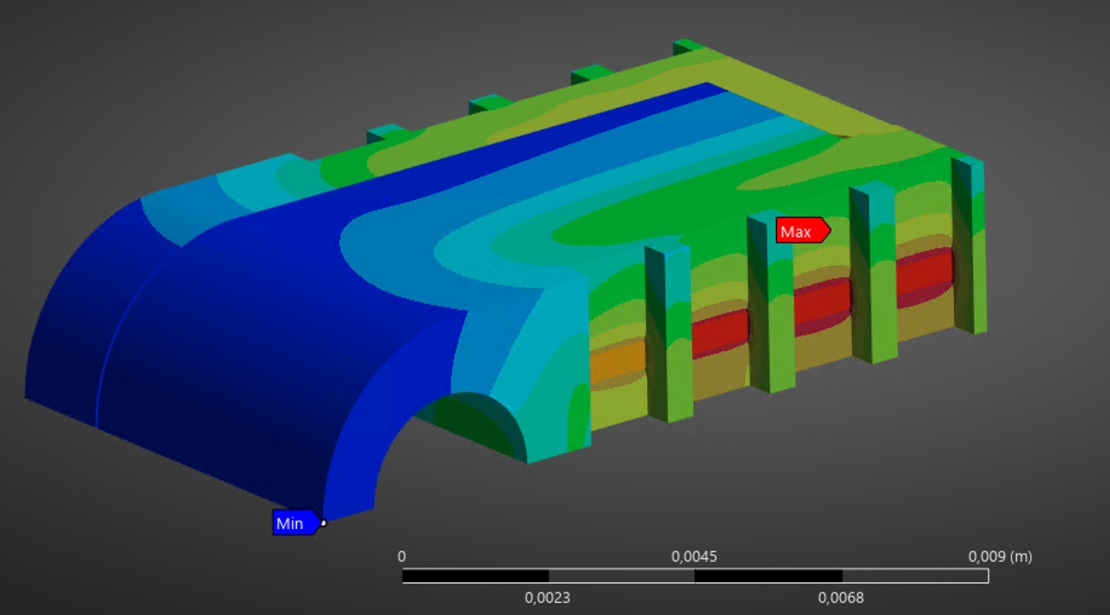
When designing systems for harsh environments, part of the schedule is set on the test bench. That is sometimes where a flaw surfaces: a resonant frequency that falls within the operational excitation range, an underestimated thermal stress, a deformation under load that the drawings gave no hint of, or contact wear that only appears after several cycles.
As long as the only way to know whether a part will hold up is to build it and then test it, every doubt costs time. You launch a prototype, instrument it, subject it to vibration and temperature variation, analyze, correct, and start over. Each loop adds several weeks to the schedule, not counting the tooling and the lab time it ties up.
Three pressures bearing on the same schedule
An engineer preparing for a qualification never manages just one constraint. They manage three at once.
- Time. The pressure on time-to-market is constant, and each physical prototyping iteration delays the validation date.
- Qualification. MIL, EN, and ESCC standards require demonstrating resistance to sinusoidal and random vibration, mechanical shock, thermal cycling, and static and dynamic loads. These requirements are non-negotiable, and the final verdict often comes at the end of the cycle, when the schedule is already tight.
- The cost of the late error. A flaw found on the bench forces you to rework the design, launch another prototype, and book the test facilities again. The real cost of an iteration is not the cost of the part: it is the time lost.
What these three pressures have in common is uncertainty. As long as you cannot observe how a system behaves before building it, you press ahead and defer the verdict to the very end.
Observing real behavior before building
This is precisely the point that mechanical simulation shifts. Rather than discovering how a piece of equipment behaves on the bench, you observe it beforehand, in a digital environment, under conditions representative of its real-world use.
At Nicomatic, this capability takes the form of a dedicated service, Atlas Simulation, built on Ansys, a benchmark in numerical finite-element simulation. The goal is not to replace testing but to prepare for it: to arrive at the bench with a design that has already been roughed out, with its weak points identified and corrected virtually.
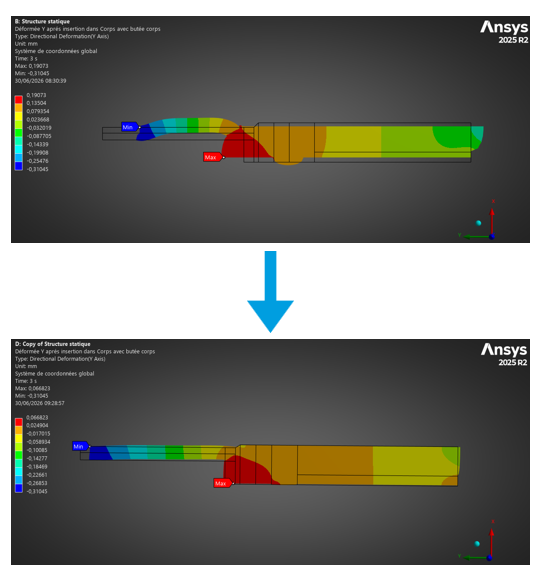
Atlas covers several types of analysis, corresponding to the very failure modes you are trying to rule out before fabrication:
- Thermal and mechanical stresses, to verify performance under load and temperature.
- Vibration, to locate resonant frequencies and anticipate dynamic behavior.
- Deformation, to visualize the weak zones under stress.
The value is not just in "seeing": it is in being able to correct the geometry, the materials, or the integration, then re-run the analysis within a few days, where a physical loop would take several weeks.
What does this change, in practice, on the schedule
In a typical design process, the prototyping stage runs for about three weeks, followed by two weeks of testing to refine the design. With Atlas, the initial design phase is significantly shortened, and the physical test iterations needed to refine the design give way to a simulation phase that can be completed in under a week. Repeated at each iteration, the gain becomes substantial over the life of a program.
This time saving comes with greater control. By predicting and virtually verifying the performance of a product or system before fabrication, you:
- respond more confidently to strict quality requirements, arriving at qualification with a design that has already been proven;
- firm up the design upstream, before committing to tooling and production costs;
- improve responsiveness to customers by reducing back-and-forth;
- shorten time-to-market.
Mechanical simulation does not eliminate testing. It shifts its timing: instead of waiting for the bench to discover a design's weaknesses, you address them upstream, while they are still easy and inexpensive to correct. For an engineer, this means fewer iterations forced upon you, a better-prepared qualification, and a schedule that holds. It is, very concretely, design time saved.
And if the mechanical, thermal, or vibration performance of your system is a concern for your current project, the best time to discuss it is before the first prototype.