

An enclosure sealed under dry nitrogen, protected electronics, months of qualification. Then, after a few hundred thermal cycles, condensation forms on the board. The cause: a micro-leak at the connector. For the engineers who design this equipment, the connector is not a finishing detail. It is often what separates a reliable system from a failed one.
Maintaining a controlled atmosphere inside a piece of equipment almost always forces a trade-off. Catalogue hermetic connectors withstand the pressure differential, but at the cost of added bulk or density. Compact, high-density connectors, on the other hand, were never designed for it. And as soon as you step outside the standard, a non-catalogue route too often means long lead times and high minimum quantities.
The real problem is not water; it is the pressure differential
Any engineer knows it: sealing is not just about keeping water out. The real challenge lies elsewhere, more subtle and more demanding.
As soon as a pressure differential exists (altitude, immersion, the vacuum of space, or simply an enclosure filled with inert gas), the interface has to hold it steadily, thermal cycle after thermal cycle, vibration after vibration. An interface that breathes eventually draws in humid air with every temperature swing: condensation, corrosion, leakage currents, dendrite growth, all the way to failure. In a vacuum, the risk reverses: it is the internal atmosphere that escapes, causing low-pressure electrical discharge. In both cases, the most critical point is often the same: the wall feedthrough.
It is precisely for this feedthrough that hermeticity takes on its full meaning, and why an IP rating alone is not always enough. IP67 protection withstands dust and temporary immersion; true hermeticity targets a level of a different order, measured no longer in drops but in helium leak rate.
What the word “hermetic” really demands
Designing a reliable feedthrough means reconciling several constraints that are each already difficult on their own:
- Holding the leak rate over time, not just at the first acceptance test.
- Surviving thermal cycling and vibration without the gasket or the seal fracturing (−55 °C / +125 °C, shock, harsh environments).
- Preserving signal integrity: a sealed solution is worthless if it degrades EMI shielding or impedance.
- Respecting SWaP (Size, Weight and Power): gaining sealing must not come at the cost of added mass, volume, or contact density.
- Fitting the enclosure: mounting method, materials, wall geometry. Every piece of equipment imposes its own constraints, rarely anticipated by a catalogue.
Each of these constraints can be solved. Bringing them together in a single connector, however, often goes beyond what a catalogue part can offer.
Starting from a platform already built for harsh environments: the DMM
Our approach is not to reinvent a connector around sealing, but to start from a platform already proven in harsh environments and adapt it.
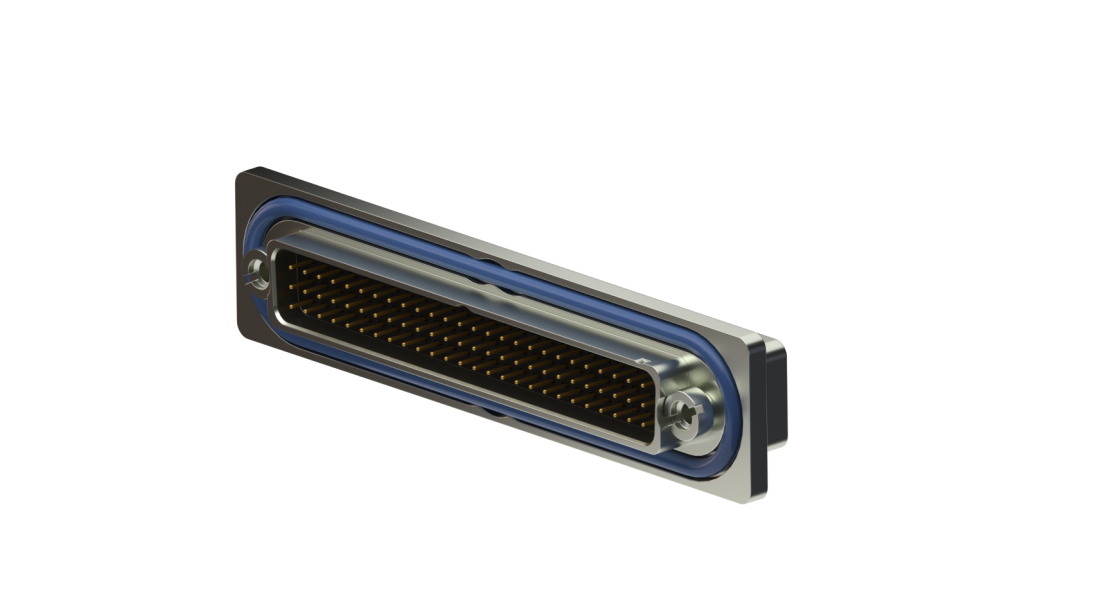
The DMM is a 2 mm pitch metal connector designed for extreme applications:
- Performance beyond the MIL-DTL-83513G standard
- 360° EMI shielding to protect signal integrity
- Low-profile aluminium shell and 90° right-angle contacts, for high density (up to 4 rows)
- Combo layout: coax, power, and signals combined in a single connector
This last point is a major advantage when every panel feedthrough is costly to seal: fewer interfaces to seal means fewer potential leak paths.
On this base, several levels of protection are available:
- a DMM IP67 version, dust- and water-tight for harsh environments, potted and fitted with fluorosilicone seals;
- an enhanced sealing option, based on a hermetic compound technology, with a maximum leak rate on the order of 1×10⁻⁷ He.
Extending the same logic to the D38999
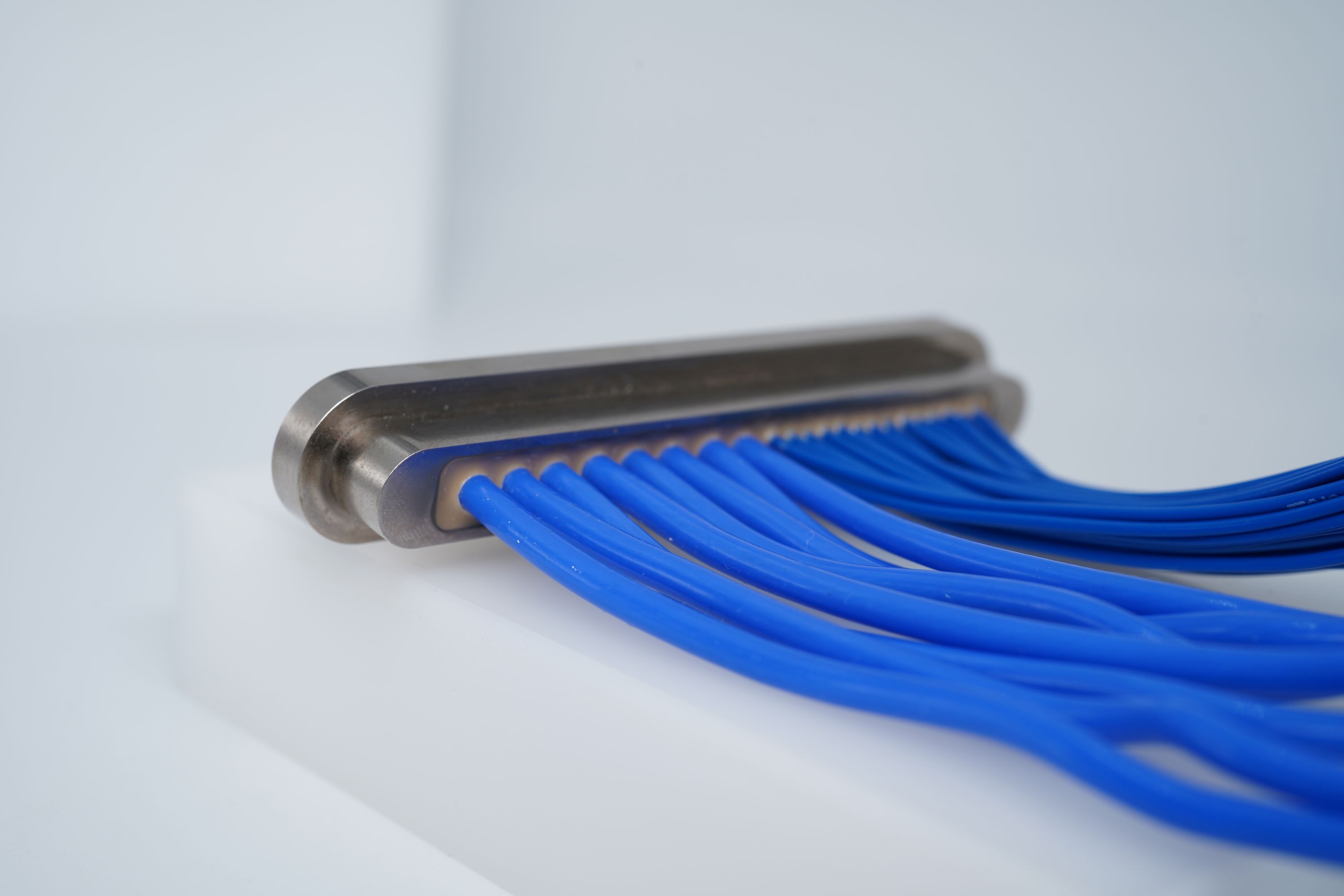
For circular platforms, the aluminium D38999 range is a widely recognised foundation. Enhanced sealing is achieved here through our in-house potting processes:
- epoxy back-potting
- flexible, temperature-resistant silicone potting
- high-pressure overmoulding
These are complemented by our backshell range for mechanical and EMI protection.
The idea stays the same: adapt a proven standard rather than force a compromise on you.
Where Advanced Solutions make the difference
Most sealing requirements never fit a catalogue part perfectly. That is why our Advanced Solutions rely on a dedicated project team, co-development, fast prototyping, and an in-house test laboratory to validate sealing and performance before production. Two further advantages make it easier to take the step: a minimum order quantity of one piece, which lets you test a configuration without committing to a volume, and short lead times, so you can iterate quickly and hold your milestones. Rather than forcing a catalogue part to fit, you get a response built around your constraint: we clear the point blocking your design, then guide you from enhanced sealing toward a hermetic solution as your need becomes clearer.
On a potted connector, the final seal also depends on the quality of assembly. For teams that bring cabling in-house, our IPC-certified trainers train your operators in sound assembly practices, so that the performance validated in the laboratory is reproduced on every part you produce.
An enclosure under dry nitrogen should never lose its atmosphere because of its connector. If your equipment has to hold a pressure, a gas, or a controlled atmosphere, let us talk about it from the design stage.