

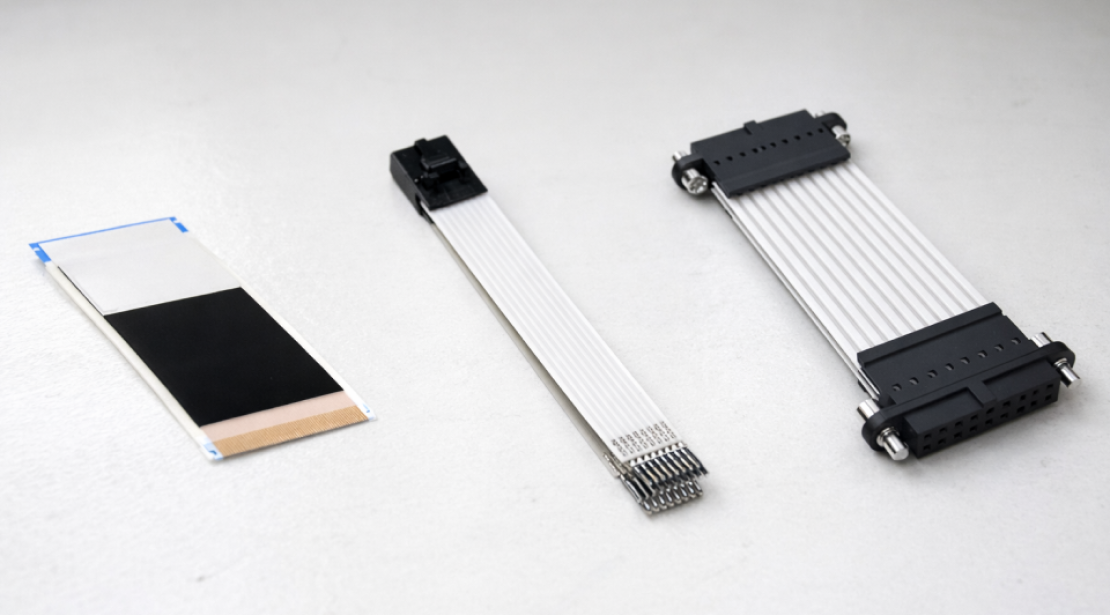
Whether your flat flexible cable is integrated inside a control cabinet or an embedded system exposed to extreme vibrations, the requirements are not the same at all. While flat cables are essential for solving weight and space constraints, their reliability depends directly on the environment in which they operate. Discover how to identify the flexible interconnect technology that will precisely match your specifications, without oversizing your budget.
Choosing a flexible interconnect solution is not simply about linking two boards. It is about ensuring system reliability in its target environment. An under-specified interconnect will lead to failure in the field, while an over-specified solution will drive up costs unnecessarily.
To help you make the right choice, here is a comparison of our three flexible interconnect technologies, ranked by their level of environmental resilience.
1. FFC Cables (ZIF/LIF): Efficiency and compactness for controlled environments
If your design operates in a stable environment, without major mechanical or vibration constraints, flat FFC cables (Flexible Flat Cables) combined with standard ZIF/LIF connectors are the most cost-effective and compact solution.
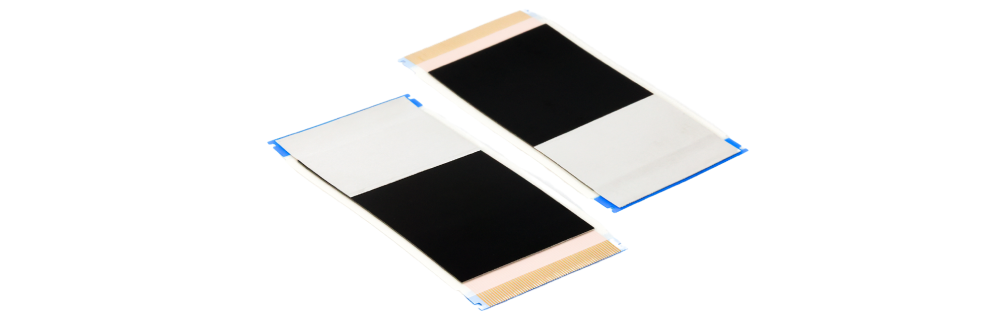
- Technical profile: Designed with laminated tin-plated copper conductors (from 2 to 250 conductors), they offer a minimal footprint with ultra-fine pitches ranging from 0.5 mm to 2.54 mm. While their mechanical retention at the connector level remains standard, they compensate with high thermal reliability (withstanding -55°C to +105°C for UL solutions) and excellent electrical performance. Shielding and controlled impedance options are also available to guarantee signal integrity, even in high-density designs.
- Ideal applications: Internal connections inside closed enclosures, board-to-board links, embedded display interfaces, or any application requiring significant space savings on the PCB.
- Target environment: Standard and controlled (no vibration, shock, or repeated handling).
Explore FFC cables in the configurator →
2. CrimpFlex™ Jumper Cables: Reinforced mechanical retention for the first level of constraints
When your system begins to face handling or industrial conditions, the retention of a standard FFC with a ZIF connector may no longer be sufficient. This is where the CrimpFlex™ range comes into play.
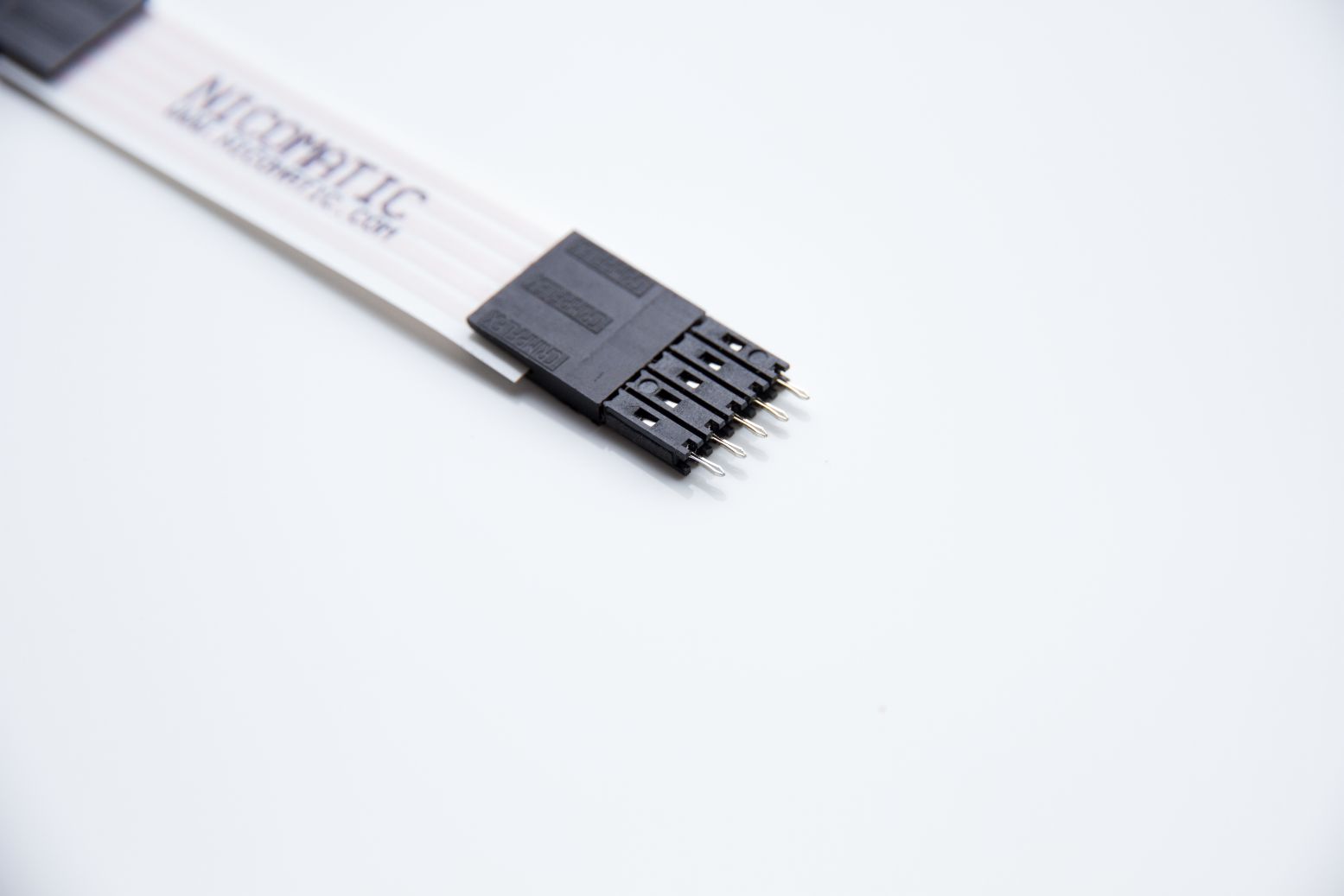
- Technical profile: Instead of being simply inserted, the ribbon cable is fitted with crimped contacts (up to 50 at a time) and paired with dedicated housings (with 1.27 mm or 2.54 mm pitch). This provides excellent mechanical retention force. It is also an excellent alternative to discrete wire, enabling weight savings of 20% to 30%.
- Ideal applications: Industrial systems, human-machine interfaces (HMI), instrumentation, and applications requiring reliable folding or routing. This versatility is further enhanced by the system's high modularity, allowing for easy flat cable-to-board, flat cable-to-flat cable, or even flat cable-to-discrete wire connections.
- Target environment: Moderately harsh (improved resistance to moderate vibration, wear, and handling).
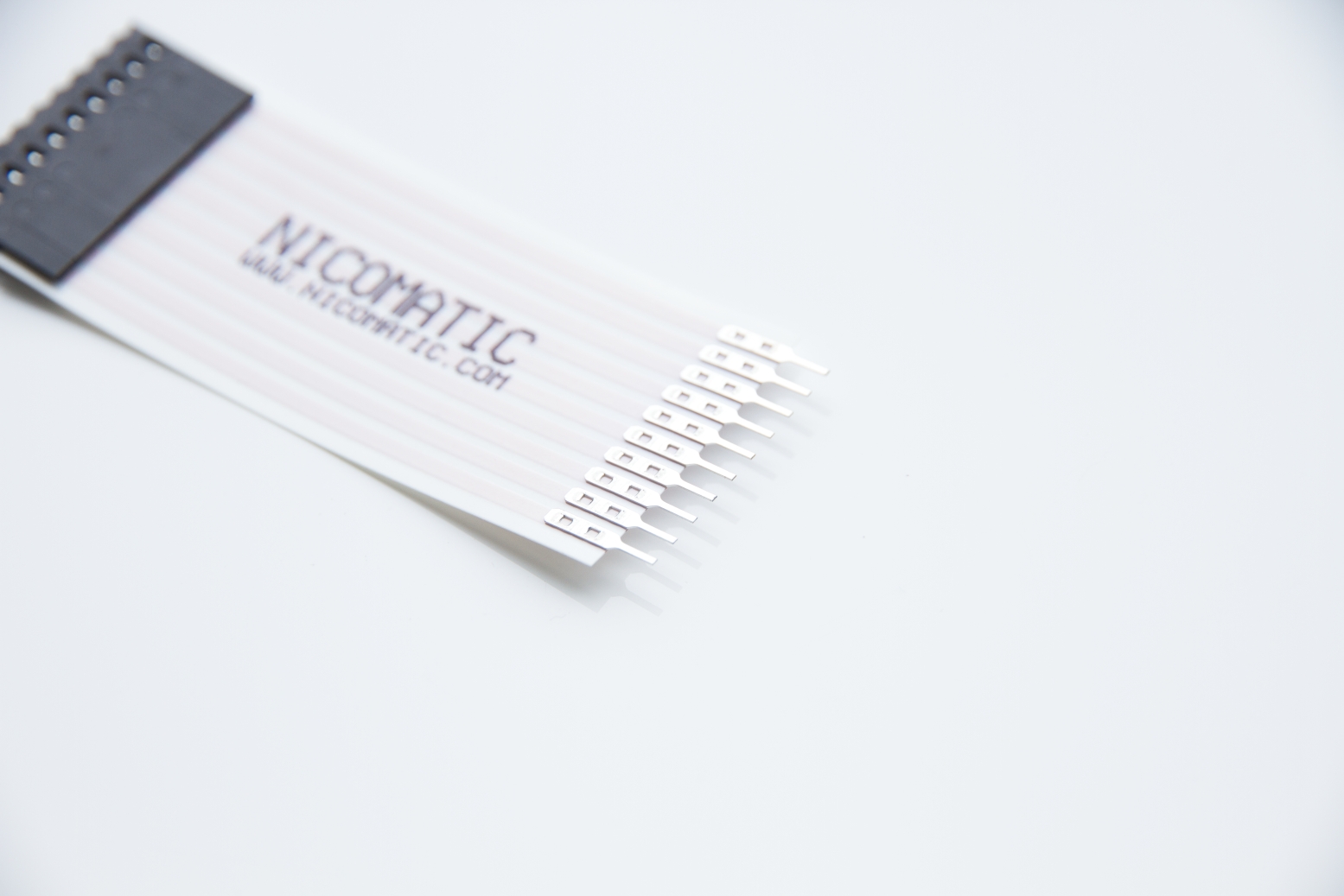
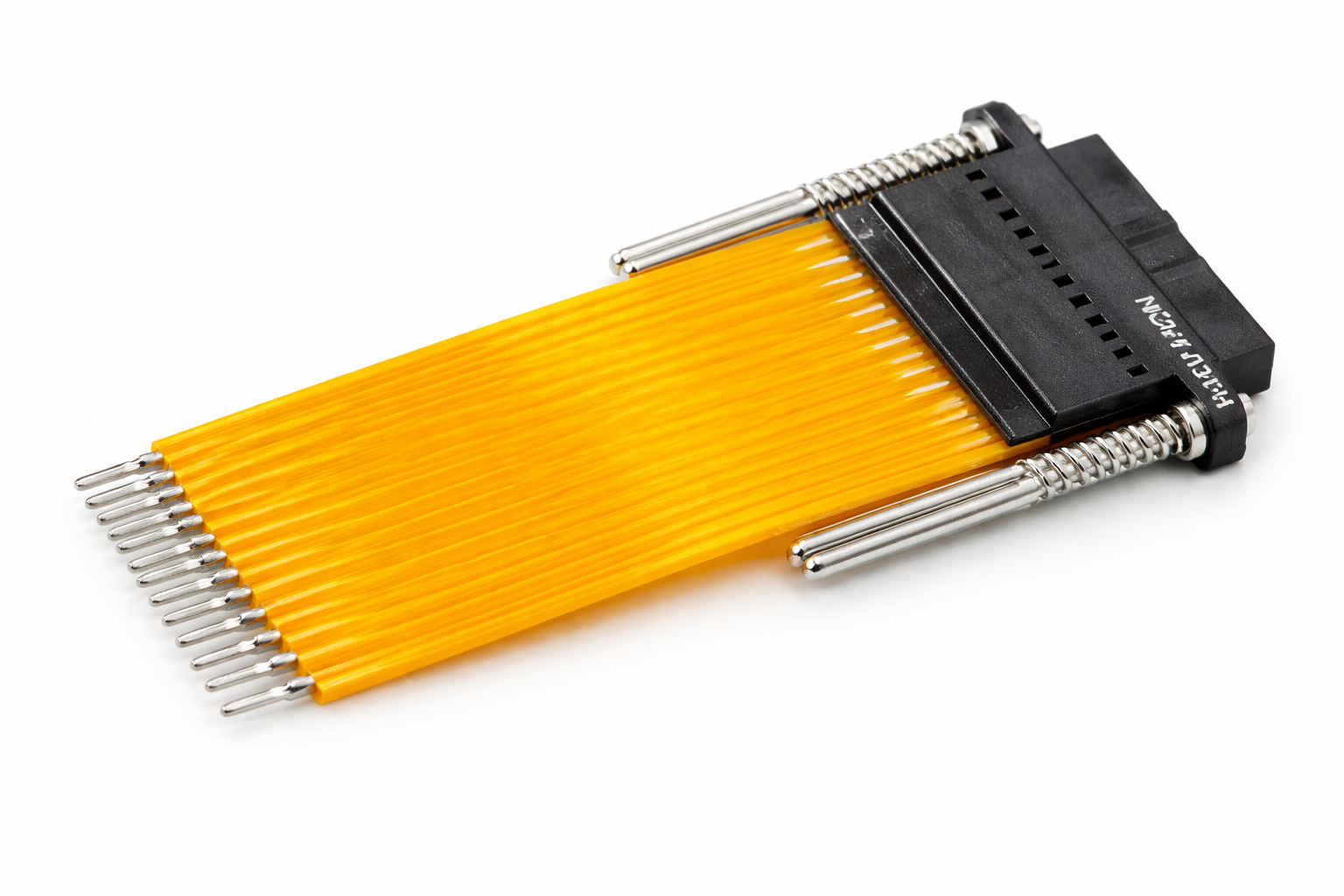
3. Microflex™ Harnesses: Absolute reliability for extreme and high-vibration environments
For your critical projects, Microflex™ technology is the ultimate answer. It combines the space-saving benefits of a flat cable with the ultra-robustness of a high-reliability connector.

- Technical profile: This 2 mm pitch interconnection system features screw hardware and mates with Nicomatic's renowned CMM 220 connectors. Tested to the rigorous MIL-DTL-55302F standard, the Microflex™ offers extreme resistance to shocks and vibrations, while reducing weight by up to 60% compared to a round discrete wire harness (up to 60 LF signals – 3A). Furthermore, for the most severe thermal environments, a Kapton (polyimide) version is available, extending heat resistance up to +125°C.
- Ideal applications: Aeronautics, defense (MIL-AERO), advanced robotics, critical medical equipment.
- Target environment: Very harsh (continuous high vibration, intense shocks, hostile thermal variations).
The success of your design depends on anticipating its operating conditions. Choosing the right flexible interconnect technology — whether FFC, CrimpFlex™, or Microflex™ — allows you to secure your interconnects while optimizing your budget and avoiding the trap of over-specification. A technical question ?