

There is a moment every embedded systems designer knows. The PCB is nearly finished, the routing holds together, and the footprint is under control. Then one more function lands in the specification: an extra link, an additional sensor, a data lane to bring out. And there is no room left.
That moment is nothing exceptional. It is fast becoming the norm. In defense, aerospace, space, drones or small satellite constellations, the underlying trend is clear: more electronics per platform, in envelopes that are not getting any bigger. More functions, more heat to dissipate, and an assembly constraint that has to stay simple and light.
Faced with this, two reflexes come up again and again. Cutting corners elsewhere, by accepting a compromise on another part of the design. Or spreading the interconnect across several connectors, multiplying footprints on the PCB. Both carry a hidden cost: added mass, a growing bill of materials, extra assembly operations, and just as many points where something can go wrong.
Yet the real problem is not the number of functions to integrate. It is the received idea that density must always come at the expense of reliability.
Three constraints that stack up on the same board
When an engineer sets out to save space, they never deal with just one constraint. They deal with three at once:
- Integration space, which shrinks as functions pile up.
- Thermal concentration, which rises as contacts are brought closer together and current flows through them.
- Assembly, which has to stay fast, light and repeatable, from prototype to production.
In other words, the real question is not only "how do I save space?", but "how do I save space without degrading behavior in harsh environments?". That is exactly where the choice of a high density connector comes into play.
Density as a method, not a sacrifice
This is the constraint Nicomatic's interconnect solutions are built to tackle head-on, with a range designed to offer several levels of integration depending on the pitch and format you need. Rather than a single connector meant to do everything, the idea is to have the right pitch in the right place.
The board-to-board connector: Matr'YX
When the constraint is stacking boards, the Matr'YX board to board connector is arguably the most relevant answer in the catalog. It is a mezzanine connector with BGA termination at 1 mm pitch, packing up to 70 contacts per cm², from 49 to 301 contacts, with an adjustable stack height from 5.5 to 14.5 mm.
Its mechanical signature matters as much as its numbers: each contact rests on 4 contact points per socket, which is rare at a 1 mm pitch and reinforces resistance to shock and vibration. Compatible with underfill to extend the service life of the PCB assembly, engineered for defense and space, it also carries high-speed data.
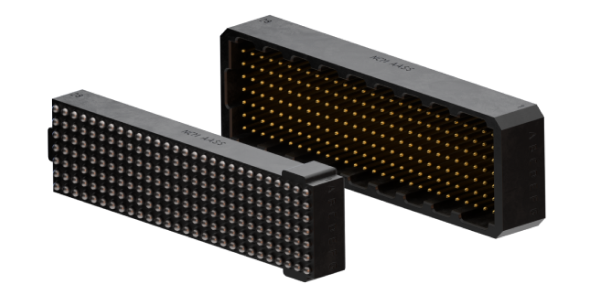
Matr'YX, 1 mm pitch BGA mezzanine
The best performance-to-size ratio: EMM
When the need is a rugged miniature connector at board level, the EMM compact connector at 1.27 mm pitch claims the best performance-to-size ratio on the market, with up to 40% space saving. From 4 to 60 contacts, available in through-hole and SMT, with a metal shell, it exceeds the performance of the MIL-DTL-83513G standard and accepts mixed layouts combining power and signal in a single housing. All of this with no minimum order quantity.
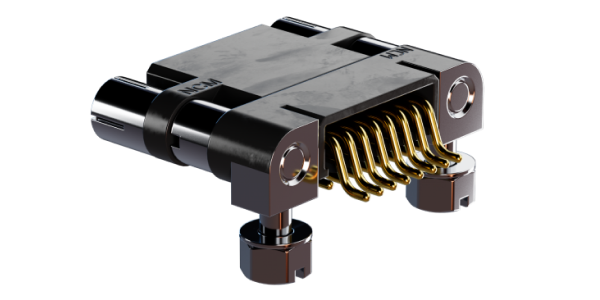
EMM connector pair, SMT right-angle on PCB
When every contact counts: AMM, CMM and DMM
For the most miniaturized needs, the AMM connector at 1 mm pitch plays the ultra-compact, ready-to-use card: a miniature connector available off the shelf, in tape and reel for automation, with a minimal footprint.
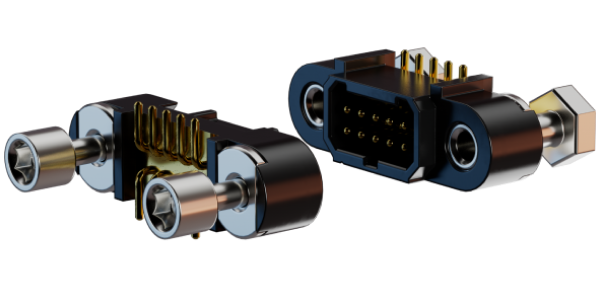
AMM connector pair, SMT straight on PCB
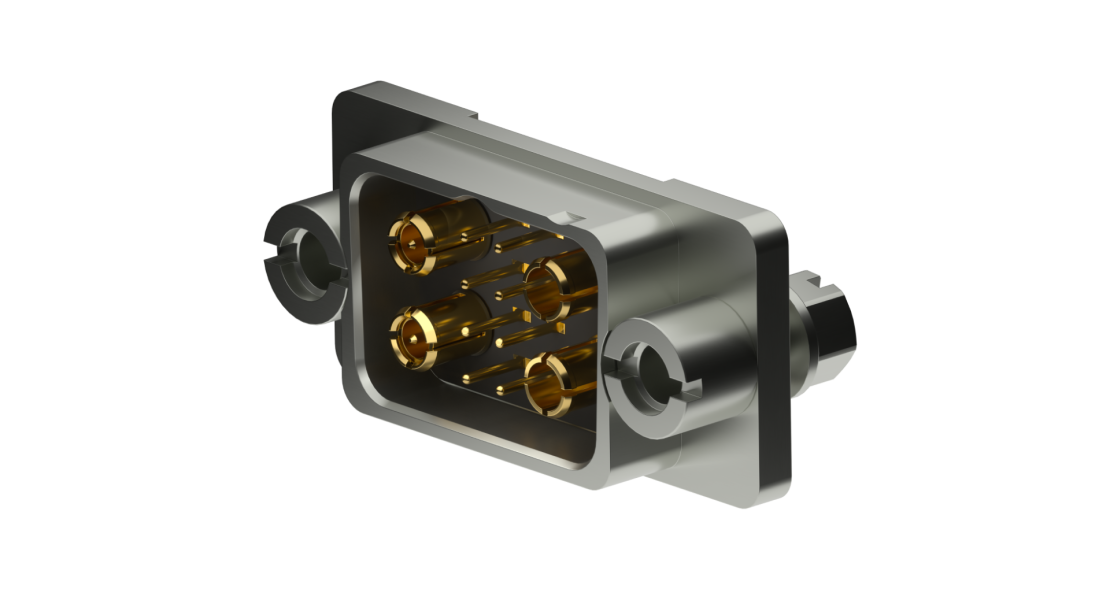
At 2 mm pitch, the CMM connector offers the space and weight saving of a micro-connector while staying very dense, notably in its series 340. Its configuration logic is worth knowing. Larger than the signal contacts, the power (HP) and coaxial (HF) contacts sit straddling 2 rows of the grid, where they take up the space of 3 signal contacts. In practice, you drop coaxial or power straight into the layout, without adding a dedicated connector alongside, and without breaking the density of the signal section. You are the one who arbitrates the split between signal, power and coaxial to suit your application, through a single interface.
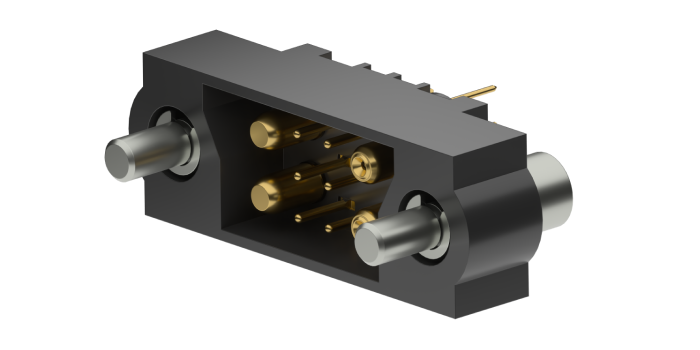
CMM Series 340, Multi-Mix layout with 2 coaxial and 2 high-power contacts
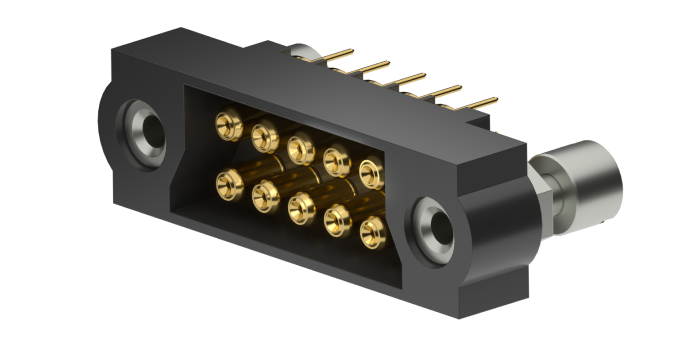
CMM Series 340, 2 rows of coaxial contacts
Finally, the DMM connector, at 2 mm pitch, lets you densify up to 4 rows in a low-profile aluminium shell. It accepts mixed layouts: the bulkier power and coaxial contacts sit across 2 rows, letting you bring signal, power and coaxial together in a compact footprint. Enough to fit many positions into a controlled envelope, without sacrificing mechanical protection.
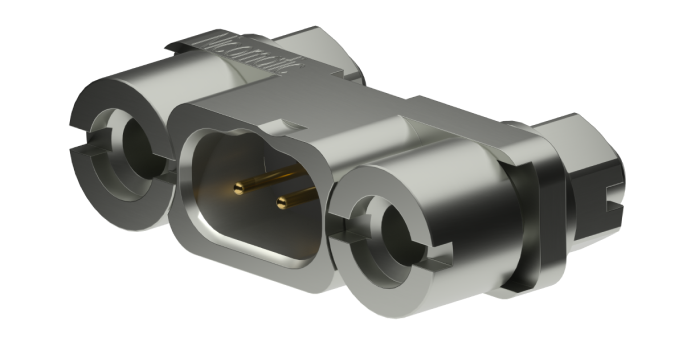
DMM Series 100, 2 signal contacts
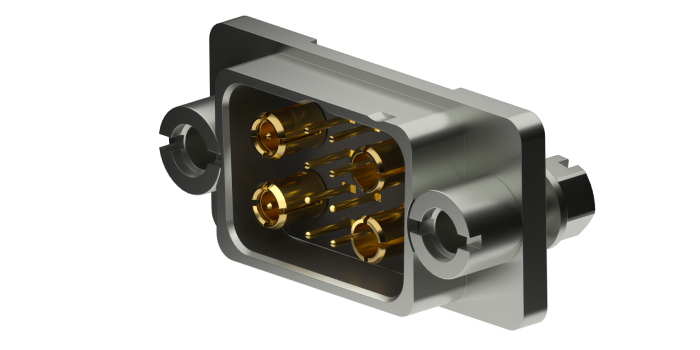
DMM Series 420, Multi-Mix layout with 2 coaxial and 2 high-power contacts
Saving space on the cabling too: MicroFlex
Density does not stop at the connector. A flat alternative to round wire, designed for miniaturized onboard systems, the MicroFlex cabling makes the most of its flexibility: it accepts far tighter bend radii than round cable. In practice, it slips in closer to surrounding components and enables tighter, therefore denser, routing, where a round bundle would have forced you to leave clearance. And as a consequence, it is also lighter, with up to 50% less weight on the harness.
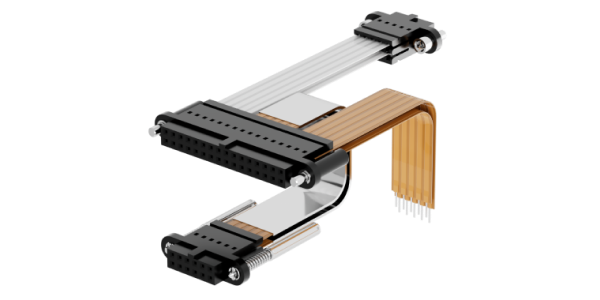
MicroFlex assembly, Octopus version with Kapton and V-shield
What well-designed density actually changes
Choosing the right high density connector, rather than stacking references, has very concrete effects on your design:
- Reclaimed PCB surface, reinvested in useful electronics.
- Less mass, from the connector all the way to the harness.
- A leaner bill of materials, with fewer references to manage and source.
- Fewer assembly points, and therefore fewer failure risks.
- Reliability maintained, with performance in line with or above MIL standards and mechanics engineered for harsh environments.
Density then stops being a compromise you put up with. It becomes a design parameter you can steer.
Every application has its own trade-offs between space, weight, current and environment. If you want to compare possible configurations or have a high density connector choice checked by our engineers, let's talk.